
If FDA reviewed the prescriptions behind your highest-volume compounded formulations tomorrow, would the records demonstrate individualized clinical judgments, or a pattern suggesting that the stated rationale did not genuinely drive the prescribing decisions?
FDA has now raised that question in writing.
In its September 18, 2026 warning letter to Empower Clinic Services, LLC d/b/a Empower Pharmacy, FDA stated:
“The volume of products you are producing suggests that differences between products you are compounding and the FDA-approved products are pretextual”
and that generating prescriptions for those products
“through means that undermine the individualized nature of a prescriber's clinical judgment (for example through third-party technology platforms that provide prescribers with pre-selected menu options for choosing a statement of significant difference) call the individualized nature of those determinations into question, potentially undermining claims that such prescriber determinations of significant difference are sufficient to meet the conditions of section 503A.”
That is the clearest public statement yet of how FDA intends to identify and prove pretext, meaning that the stated reason for the compounded product is not the real reason it is being prescribed, in large-scale compounding programs. It should reframe how every 503A pharmacy, telehealth platform, and prescribing organization thinks about scale.
To be clear, the letter is broader than this article. FDA also alleged insanitary conditions, inadequate smoke studies and media fills, CGMP deficiencies, data integrity concerns, unapproved new drug violations, misbranding, and other quality system failures – but those downstream consequences largely stemmed from what could be described as the 'original sin' of significant difference pretext. While they are notable because FDA moved beyond the public-facing marketing claims that characterized much of its earlier compounded GLP-1 enforcement activity and instead conducted an internal inspection of records, workflows, systems, production volumes, and operational evidence supporting large-scale compounding, the allegations themselves can be catalogued quickly into a single visual reference. See Figure 1.
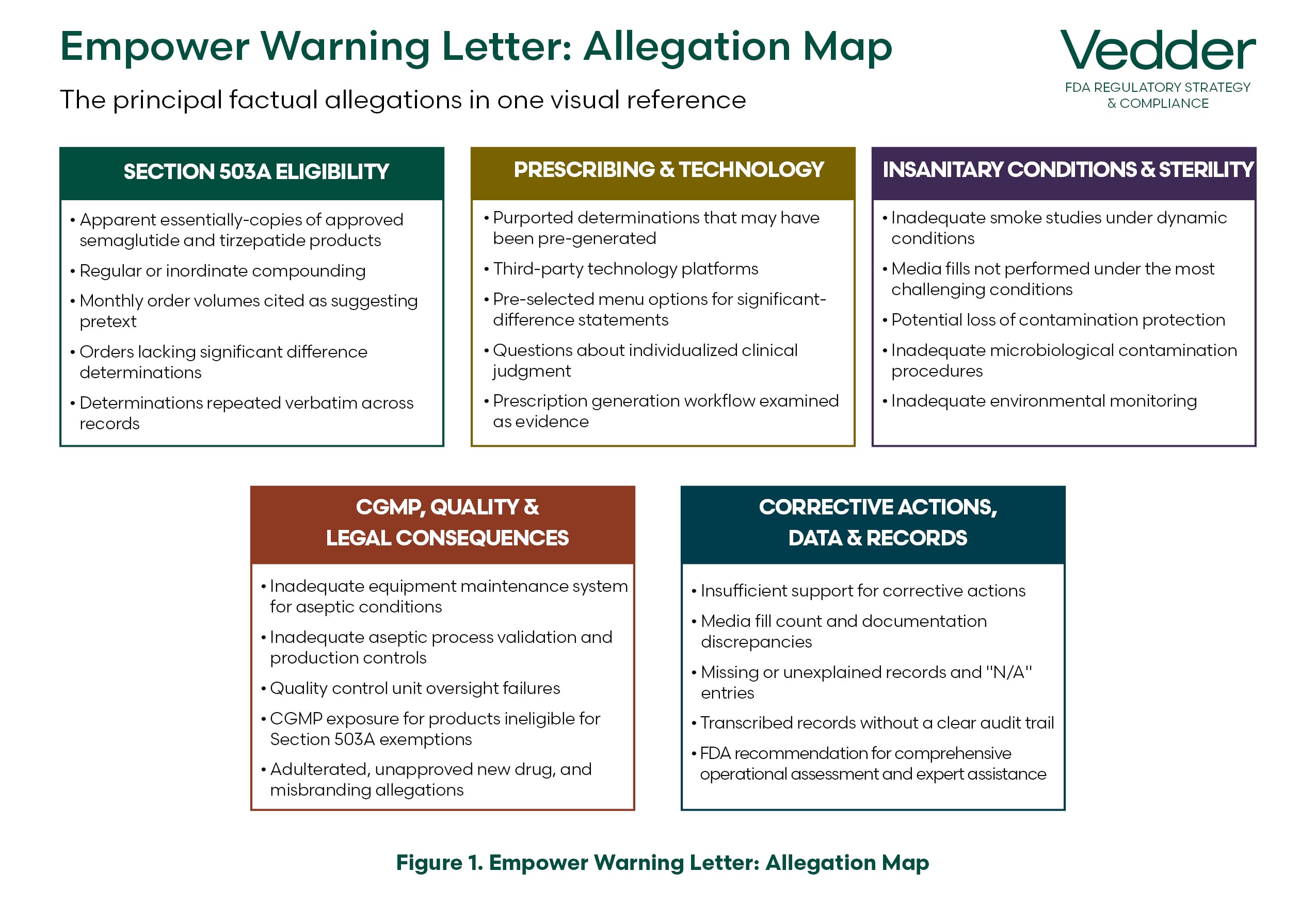
This article focuses on the warning letter’s critical underlying question: what evidence a prescribing system generates about why prescriptions are written and whether that evidence, in the aggregate, supports or undermines the claim that a significant difference genuinely drove the prescribing decision.
That is where Prescribing Architecture becomes useful.
Pretext Is Not New. Empower’s Evidentiary Approach Is.
The concept of pretext did not originate in Empower. FDA’s January 2018 guidance Compounded Drug Products That Are Essentially Copies of a Commercially Available Drug Product Under Section 503A of the Federal Food, Drug, and Cosmetic Act quoted the congressional conference report’s statement that:
“where it is readily apparent, based on the circumstances, that the ‘significant difference’ is a mere pretext to allow compounding of products that are essentially copies of commercially available products, such compounding would be considered copying of commercially available products and would not qualify for the compounding exemptions if it is done regularly or in inordinate amounts.”
The examples quoted in the guidance were narrow:
- minor strength changes not known to be significant; and
- prescriptions influenced by remuneration or other financial incentives.
Empower appears to supply the next chapter. It connects the pretext conclusion to product volume, prescriptions lacking significant difference determinations, determinations repeated verbatim across records, statements that appeared pre-generated, and third-party technology offering pre-selected options. FDA concluded that those circumstances were suggestive enough of pretext that the products were treated as essentially copies being compounded regularly or in inordinate amounts and therefore did not qualify for the compounding exemptions.
Prescribing Architecture: The Operational Framework
Empower raises a question larger than any one formulation, added ingredient, or significant difference statement:
What evidence does the full prescribing system generate about why prescriptions were written?
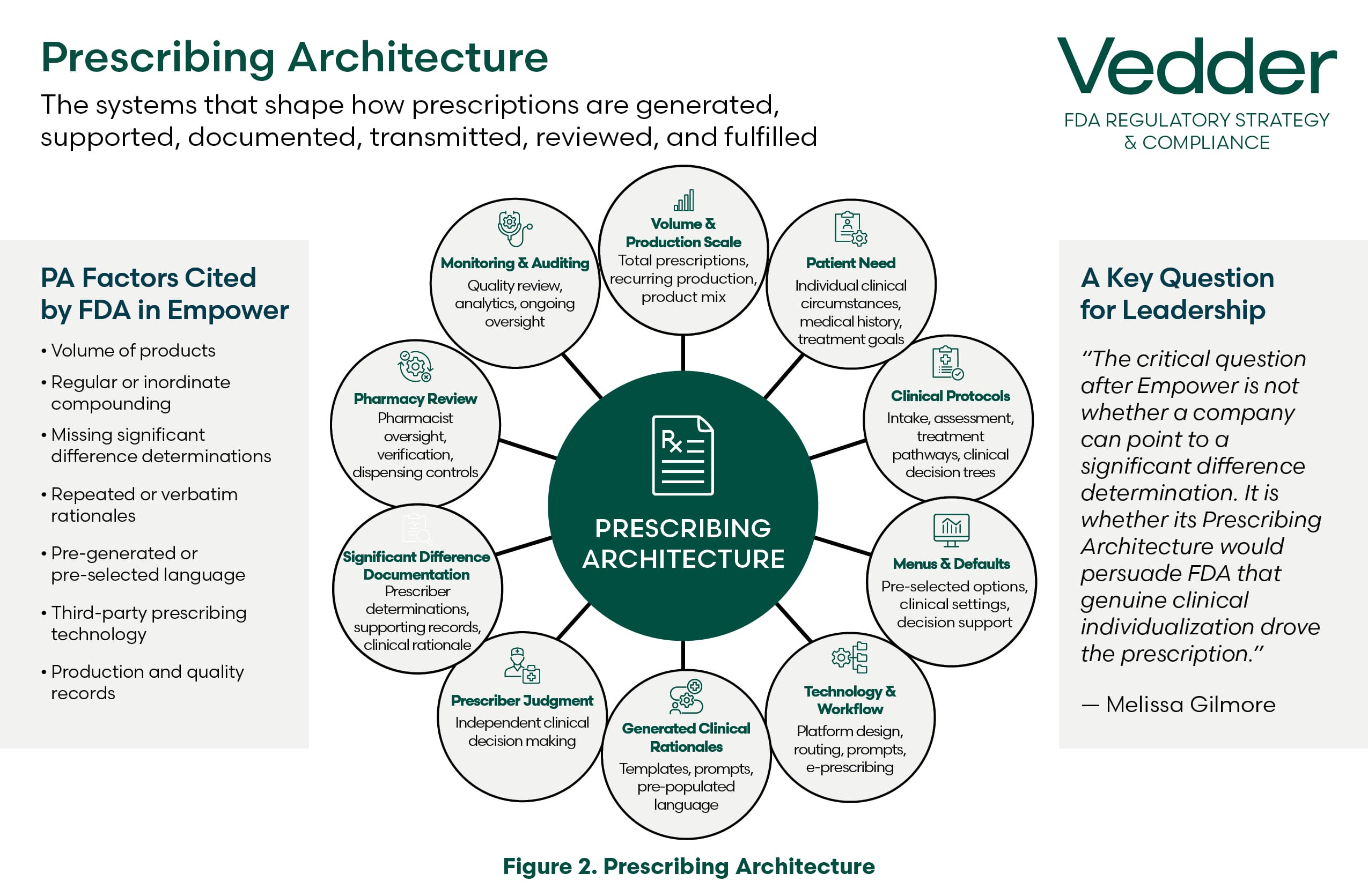
Prescribing Architecture is the sum of the systems that shape how prescriptions are generated, supported, documented, transmitted, reviewed, and fulfilled. It includes patient need and clinical history, intake, protocols and decision trees, menus and defaults, technology and workflows, generated clinical rationales, prescriber judgment, significant difference documentation, data transmission, pharmacy review, volume and production scale, and monitoring and auditing.
No single component determines whether a significant difference determination is genuine or pretextual. A menu can promote consistency without predetermining an outcome. A clinical protocol can support sound judgment. Technology can improve information collection, documentation, and access to care. Similar patients may appropriately receive the same formulation for the same clinical reason.
But the Prescribing Architecture creates the record FDA ultimately sees. The critical question is whether a company’s Prescribing Architecture would persuade FDA that the claimed significant difference genuinely drove the prescribing decision. A persuasive Prescribing Architecture should, therefore, generate aggregate evidence consistent with genuine clinical individualization and avoid creating circumstances that make pretext readily apparent. Figure 2 illustrates the elements of Prescribing Architecture.
The Significant Difference Gateway
Section 503A provides that a compounded drug is not essentially a copy when a change made for an identified individual patient produces a significant difference for that patient, as determined by the prescribing practitioner. FDA’s 2018 Essentially Copies Guidance states that the prescription or notation should identify the relevant change and the significant difference it produces. That determination is the gateway.
If a product is not essentially a copy because of a genuine patient-specific significant difference, the restriction on regularly compounding or compounding in inordinate amounts does not apply. And the product qualifies for Section 503A’s exemptions from new drug approval, adequate directions for use labeling, and CGMP requirements, provided the other statutory conditions are satisfied.
That is why pretext matters. In shorthand, pretext defeats significant difference.
The Formulation Alone Does Not Resolve the Issue.
The 2018 Essentially Copies Guidance states that a compounded product containing the active ingredients of two or more commercially available products may remain essentially a copy when the applicable strength and route criteria are satisfied, absent a documented patient-specific significant difference.
FDA’s April 1, 2026 statement FDA Clarifies Policies for Compounders as National GLP-1 Supply Begins to Stabilize specifically applied that policy to compounded GLP-1 products. FDA explained that a product combining semaglutide with cyanocobalamin may still be considered essentially a copy when the applicable API, strength, and route criteria are satisfied, absent documentation of a patient-specific significant difference. Empower applied this analysis to tirzepatide/niacinamide and semaglutide/cyanocobalamin formulations. The letter did not hold that B12, niacinamide, or another ingredient can never support a significant difference for a particular patient. FDA instead questioned whether the asserted differences genuinely drove the prescriptions reflected in the records it reviewed.
In plain terms, the formulation identifies what changed. The patient-specific record must establish why that change matters for that patient. Prescribing Architecture determines how consistently and credibly that evidence is generated at scale.
Volume Is Evidence, Not an Answer
A patient-specific need does not stop being real because many patients share it. In fact, it is indisputably beneficial to public health that modern systems can connect more patients to individualized care.
Scale, standing alone, is not evidence that individualized treatment has disappeared. It does, however, make repetition and standardization visible. Volume therefore matters not as a self-executing answer, but as evidence that may reinforce or undermine the explanation supplied by the patient-specific records.
A persuasive Prescribing Architecture will generate more evidence of individualized prescribing as volume grows, not less. If the clinical rationale is genuine, the documentation is patient-specific, and the system preserves independent judgment, increasing scale should strengthen, not weaken, the regulatory explanation. Conversely, scale magnifies contrary evidence. Missing determinations, repeated rationales, pre-selected statements, weak connections between patient need and product selection, and inconsistencies among prescribing, pharmacy, production, and quality records become more visible as volume increases.
No statute, regulation, or policy establishes a numerical threshold at which patient-specific prescribing becomes implausible. With Empower, FDA is treating volume as one part of the circumstances supporting its pretext conclusion. For industry, then, the operative question is:
What does the volume, considered with the rest of the record, demonstrate about how the prescribing decisions were made?
Empower Is a Signal Map, Not a Compliance Checklist
Empower does not establish an acceptable production volume, permissible level of repetition, approved technology design, or universal evidentiary threshold for individualization. It identifies the types of circumstances FDA considered significant within that pharmacy’s Prescribing Architecture: volume, missing determinations, repeated language, pre-generated or pre-selected statements, third-party technology, and production records.
Companies should test their own models against those Empower-specific elements, as applicable, but must also assess their operations against the broader elements of Prescribing Architecture. Prescribing Architecture is not a checklist or a single operational model – it is a framework for evaluating the evidence generated by a prescribing system as a whole. Implementation necessarily varies across different business models, patient populations, technologies, workflows, and operational structures. The common objective is ensuring that the aggregate evidence generated by that system supports genuine patient-specific prescribing and does not create circumstances sufficiently suggestive of pretext to jeopardize the Section 503A exemptions.
Five Questions Leadership Should Ask Now
1. Is the asserted difference genuine and patient-specific?
Does the formulation change produce the documented clinical benefit for the identified patient, and did that benefit genuinely drive the prescription?
2. Where could our Prescribing Architecture create contrary evidence?
Could intake, protocols, menus, technology, generated rationales, workflows, pharmacy review, production scale, or oversight create evidence inconsistent with the individualized rationale?
3. Does our Prescribing Architecture preserve independent clinical judgment?
The answer turns on system design and operating evidence, not disclaimers or contract language alone.
4. Would the aggregate record support our regulatory rationale?
What would prescribing patterns, repeated language, significant difference determinations, product mix, volume, technology records, and pharmacy records communicate when viewed together?
5. Does the legal premise work today and continue to work as the business changes?
Does the evidence generated by the Prescribing Architecture support individualized prescribing at the current operating scale and under the growth, automation, partnerships, products, workflow changes, or other developments contemplated by the business?
The Investor, Lender, Acquirer, and Strategic Partner Question
Historically, regulatory diligence focused on licensure, warning letters, litigation, financial performance, and pharmacy relationships. Empower adds a more fundamental inquiry:
Does the operating evidence support the patient-specific regulatory rationale on which the business depends?
Diligence should test the Prescribing Architecture in two states:
- Does it generate a defensible record for the business as it operates today?
- Will it continue to support the same regulatory rationale under the products, partnerships, automation, workflow changes, growth, or other developments contemplated by the parties?
The answers can affect revenue durability, valuation, financing, acquisition risk, transaction structure, risk allocation, post-closing exposure, and remediation costs.s.
How Vedder Can Help
The most useful time to evaluate FDA’s question is before FDA or a strategic partner asks it.
Vedder’s FDA Regulatory Strategy & Compliance Practice offers a tailored Prescribing Architecture Review to assess whether the systems and aggregate evidence supporting high-volume compounding and prescribing substantiate genuine patient-specific significant differences or create circumstances FDA could characterize as evidence of pretext.
A Review may range from a focused red-flag assessment to a detailed evaluation of:
- patient intake and clinical protocols;
- technology design, menus, prompts, and defaults;
- significant difference determinations and supporting records;
- prescribing and production data;
- pharmacy review and dispensing controls;
- monitoring, auditing, and governance;
- consistency among legal, clinical, commercial, quality, and operational records; and
- contemplated products, partnerships, automation, growth, and workflow changes
We advise 503A pharmacies, telehealth platforms, prescriber groups, technology providers, investors, lenders, acquirers, and strategic partners on practical strategies designed to preserve commercial objectives while managing enforcement and transaction risk.
To inquire about a confidential Prescribing Architecture Review, contact Melissa Gilmore at mgilmore@vedder.com.
Sources and Further Reading